



































![[LES ECHOS] VLAD: greener and cheaper batteries by focusing on people and Industry 4.0](/modules//smartblog/images/59-home-small.jpg)
![[DEVICEMED Magazine] Battery Technologies: How to Select the Right Cell for You?](/modules//smartblog/images/56-home-small.jpg)


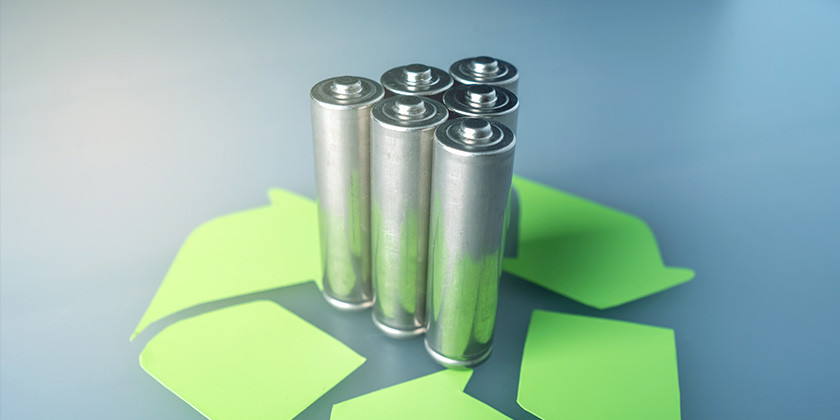
VLAD, a specialist in medical batteries since 1985, focuses its battery development efforts on virtuous choices. Eco-design and battery reconditioning are particular priorities and key elements of our commitment to achieving our goal of recycling 90% of the waste generated by our design and manufacturing activities by 2030.
Eco-design at VLAD
How does this work in practice?
For batteries designed by the VLAD design office, the latter focuses its product development on more responsible solutions by incorporating eco-design criteria into its process:
- Choice of materials: 100% recyclable aluminium for battery casings wherever possible.
- Reduction in the number of parts to facilitate future battery reconditioning.
- Choice of local subcontractors and manufacturers by our Industrial and Technical & Innovation departments: by the end of 2026, the goal is to have 85% of subcontractors located locally (within 300 km) and 80% of manufacturers located in France.
- Subcontracting: wiring/harnesses, electronic cards and equipment, other service providers (laboratories, subcontractors, etc.).
- Manufacturers: Mechanical/machining, cutting/stamping, plastic injection, 3D printing, insulation, labels, packaging.
- Assembly optimised for easy disassembly and repair: Our Methods department is involved from the earliest stages of design (design to manufacture and design to cost).
Case study: eco-design of a backup battery for a medical device

Reconditioning used batteries at VLAD
Eco-designed batteries can be recycled more easily and given a second life by being reconditioned. Once the battery is used, we replace the defective components, thereby extending the battery's life while reducing the carbon footprint associated with purchasing a new product.
New European regulation
These aspects of eco-design and repairability are included in the new European regulation on batteries (Regulation 2023/1542 of 12 July 2023), which imposes requirements in terms of durability, safety, labelling and traceability, and incorporates mandatory compliance procedures. These measures came into force on 18 February 2024 and will be phased in over a period of ten years.
All batteries placed on the European market are affected.
Committed to change: VLAD, a mission-driven company
In 2023, VLAD adopted the status of a mission-driven company.
What does it mean to be a mission-driven company?
It means that VLAD has amended its articles of association to include social, environmental and societal objectives that it is committed to achieving in concrete terms.
To ensure that these objectives are met, we have set up a multidisciplinary mission committee that includes external stakeholders. This committee is responsible for monitoring the execution of the mission and ensuring that VLAD implements the necessary means and actions to achieve its statutory objectives.
Each year, we publish a mission report detailing the actions implemented and the results achieved. In addition, every two years, an audit is carried out by an independent third party to verify the proper execution of our commitments.
Our three key commitments:
Environment: aiming for carbon neutrality and contributing to ecological transition.
Social: keeping people at the heart of our actions and promoting quality of life at work and professional fulfilment.
Societal: sharing our best practices and engaging our stakeholders in a CSR approach.
Results of our first audit (summer 2025):
The Saint Front firm scrutinised our actions... Result: Favourable opinion!
90% of the objectives in our first roadmap have been achieved, which is a great recognition of the collective work at VLAD!
View our CSR Report 2025 (in French)
Ciew our Mission Report for the 2024-2025 fiscal year (in French)
View the Independent Third Party Organisation's opinion (in French)